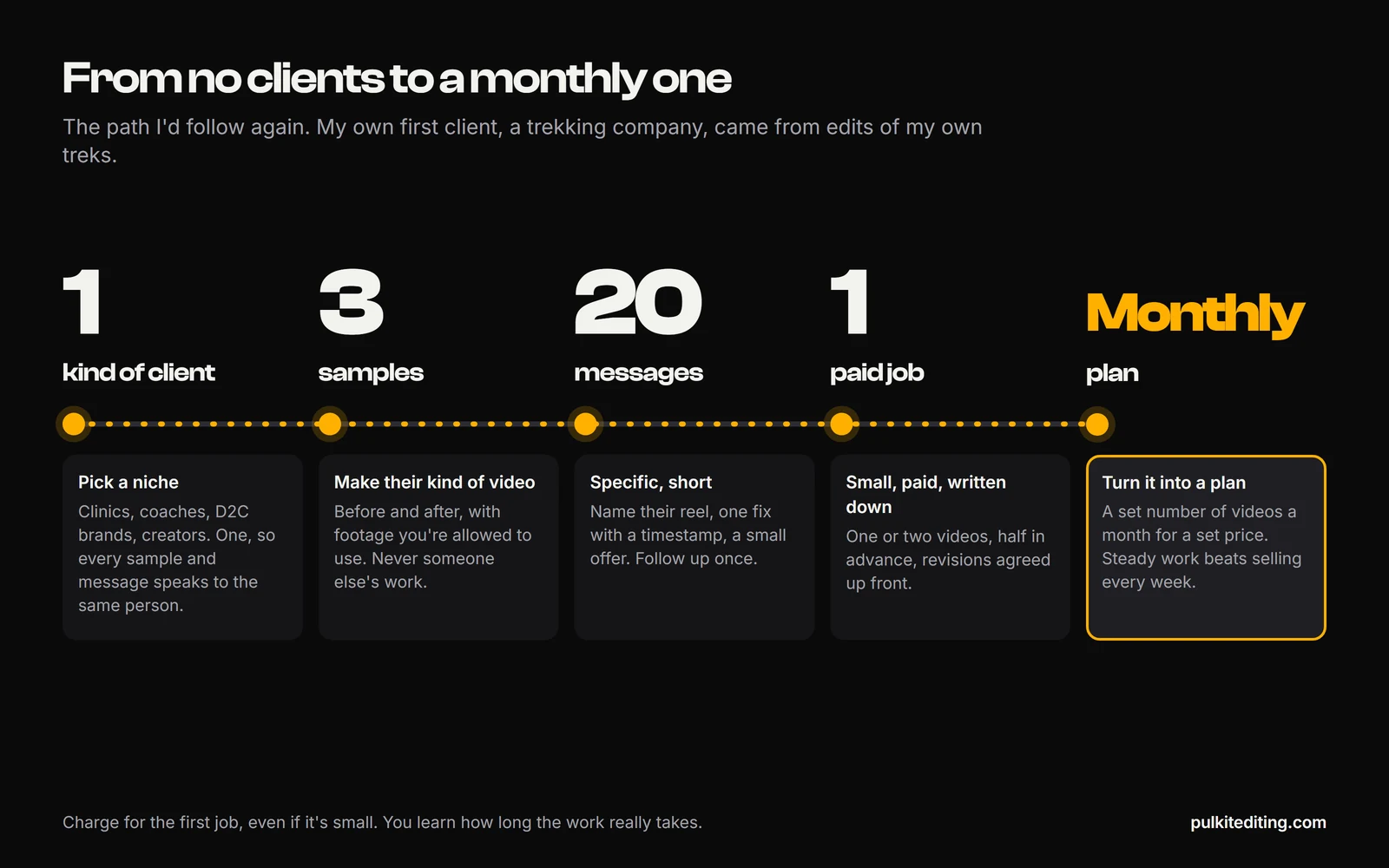
In short: make three sample edits for one kind of client, using footage you're allowed to use, and put them where that client will see them. Then message 20 people who already post videos but edit them poorly, each with one specific fix you would make. Charge for the first job, take half in advance, agree the deliverables and revisions in writing, and offer a monthly plan once the first batch goes well. My own first client was a trekking company that hired me after seeing the edits I'd made of my own treks.
How I got my first client
I'm from Dehradun, close to the mountains. Photography was my hobby, and I started filming my treks and editing them. A trekking company saw those edits and gave me a contract on the strength of them. That was my first paid work, and I haven't stopped since: five years and more than 50 clients so far.
It worked because I showed a client the kind of video they already needed, made better than what they had. My trek edits were exactly what a trekking company sells, and that is still how I'd find a first client today.
Pick one kind of client
Local businesses, coaches and founders, D2C product brands, YouTubers and podcasters, real estate: each posts a different kind of video and cares about different things. Pick one, ideally where you already have access or interest. Your samples, your messages and your Instagram then all speak to the same person, which makes every one of them sharper.
You can widen later. Starting narrow is what makes the first client say "this is exactly what we need".
Make three samples that look like their work
- Make three edits of the kind of video that client posts: if you pick clinics, three clinic reels; if you pick D2C brands, three product videos.
- Use footage you're allowed to use: your own (a phone is fine), a friend's business with their permission, or free stock footage whose licence allows it.
- Show the before and the after. The raw clip next to your version proves what you added better than a finished edit alone. Of the last twelve reels on my own Instagram, every before-and-after landed in the top half by views.
- Never put other editors' work, or a client's footage they haven't agreed to share, in your portfolio.
Where to find first clients in India
- Instagram: businesses and creators who post regularly but edit poorly. They already believe in video; they need it done better.
- LinkedIn: founders and coaches who post talking-head videos, often filmed well and edited plainly.
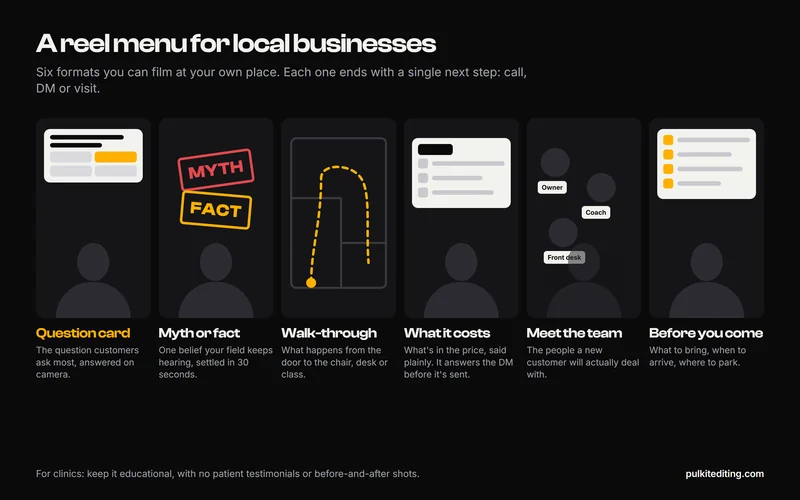
- Your own city: clinics, coaching institutes, gyms, cafés, property dealers. Walk in with your samples on your phone. I wrote about the reels these businesses need in reel ideas for local businesses.
- People you know: a relative's shop, a friend's startup, your college's events.
- Marketplaces like Upwork and Fiverr. They take a cut (Upwork's fee is set per contract, between 0 and 15%; Fiverr keeps 20% of each order) and the cheapest end is crowded, but they're useful for practice and for clients abroad.
The message that gets replies
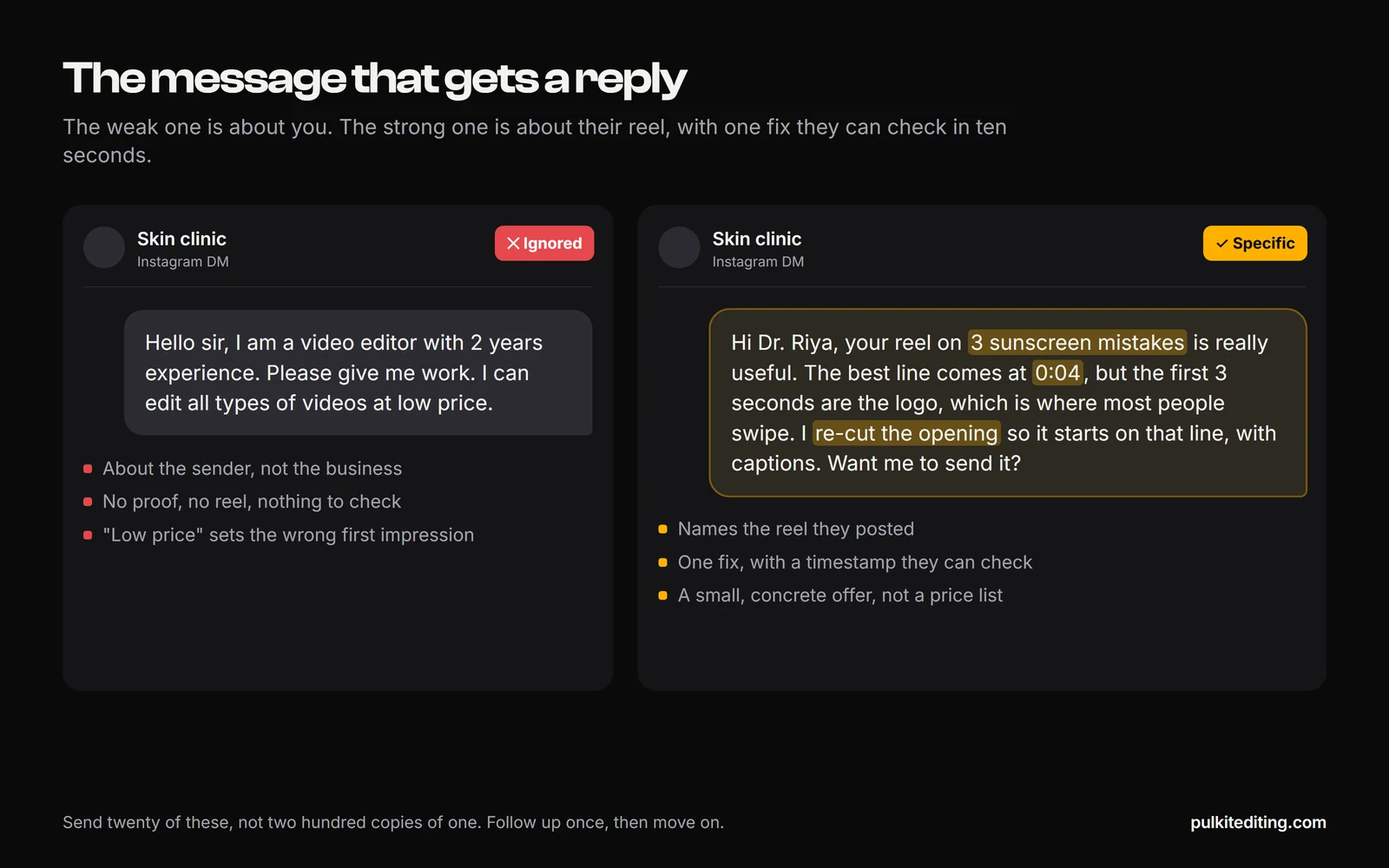
- Make it about them. Name the reel you watched and one specific thing you'd change, with the timestamp.
- Offer something small and concrete: "I re-cut the first 10 seconds so it opens on your best line. Want me to send it?" A 10-second sample in a pitch is a pitch, not free work.
- Keep it under five lines. No CV, no rates, no "sir, please give me work".
- Send 20 specific messages rather than 200 copies of one. Follow up once after a few days, then move on.
Pricing and running the first job
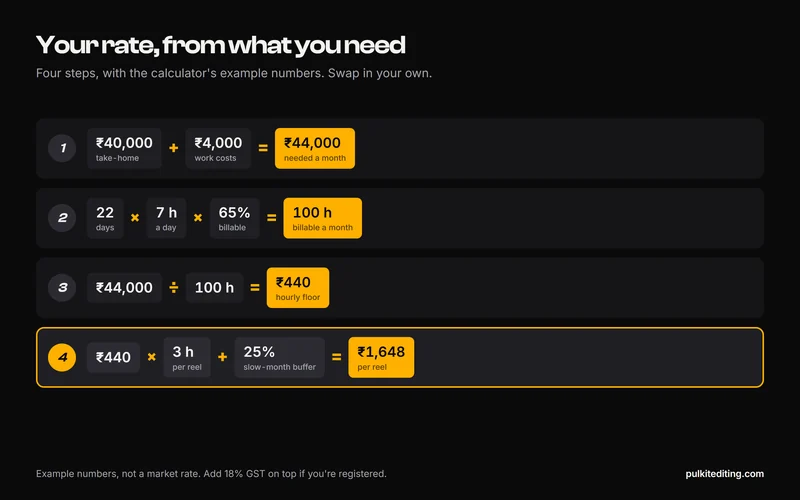
- Charge something, even if it's small. A paid trial of one or two videos makes the client take it seriously and shows you how long the work really takes. How to work out the number is in how much to charge for video editing.
- Take half in advance and the rest on delivery.
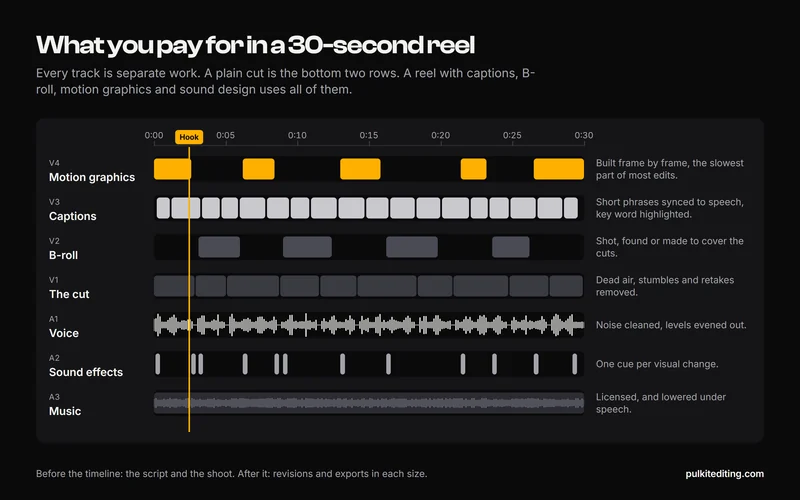
- Write down what's included before you start: the number of videos and their length, captions, music, motion graphics, how many revision rounds, the delivery date and the formats. A WhatsApp message or email the client replies "OK" to is far better than nothing.
- Send an invoice, even for small amounts, and get paid by bank transfer or UPI. In most states, GST registration only becomes compulsory once a service business crosses ₹20 lakh in turnover a year (₹10 lakh in a few special category states). Ask a CA once clients from abroad start paying you.
Turn one job into a monthly plan
Deliver a little early, with files named clearly and text checked against the Reels safe zone. After the first batch, offer a monthly plan: a set number of videos a month for a set price. Monthly clients are what make freelancing steady; one-off jobs mean finding new work every week.
Red flags in a first client
- "Edit a full video free as a test." Offer a short paid test instead.
- "We'll pay you once it goes viral", or payment in exposure.
- Unlimited revisions. Agree a number of rounds up front.
- No advance from someone you've never worked with.
- Vague ownership of project files. Decide at the start whether the editable project is part of the price.
Where to show your work
- Instagram: pin your three best before-and-afters to the top of your profile.
- A simple portfolio. At the start, a clean Google Drive folder or a single page with three videos is enough.
- LinkedIn's Featured section, if your clients are founders and companies.
- After each job, ask for a one-line review and permission to show the work. Those two things make the next client much easier.
Questions people ask
How do beginner video editors get their first client?
With three samples made for one kind of client and a short list of specific messages to people who already post videos. Show them a better version of their own kind of video, and offer a small paid first job.
Should I edit for free to get experience?
A 10-second re-cut in a pitch is fine; a full project for free usually isn't. A small paid trial makes the client take it seriously and shows you how long the work really takes.
Where can I find video editing clients in India?
Instagram and LinkedIn, among businesses and founders who already post videos; local businesses in your city; people you know; and marketplaces like Upwork and Fiverr, which take a fee from each job.
Do I need a portfolio website?
Not to start. Three strong samples, pinned on Instagram or in a clean Google Drive folder, are enough. A website helps later, when clients compare you with others.
Do freelance video editors need GST registration?
In most states it becomes compulsory once your service turnover crosses ₹20 lakh a year (₹10 lakh in a few special category states). Ask a CA, especially once you have clients outside India.