In short: founder-led video works when the founder spends their time thinking and talking, and someone else handles everything after that. My system takes one 60 to 90 minute clarity call a month and about 2 hours of recording from scripts written in the founder's voice. One editor turns that into 12 videos, about three a week, and a month-end review decides what changes.
What founder-led content is, and why buyers trust it
Founder-led content is content where the founder is the face and the voice: short videos and posts in which the person who built the company explains what they know, what they've seen go wrong, and what they believe about their industry.
It works because buyers judge companies by the thinking behind them. In the 2024 Edelman and LinkedIn B2B Thought Leadership Impact Report, a survey of about 3,500 business decision-makers, 73% said an organisation's thought leadership is a more trustworthy basis for judging its capabilities than its marketing materials. A founder explaining a problem on camera is thought leadership in its most direct form.
Why founders stop posting
Founders who give up on video rarely fail because video doesn't work. They fail on the hook and the positioning, and most of all on time. The first video takes a weekend; by the tenth there is no script, the footage sits on a phone and the account goes quiet.
Editing alone doesn't fix that, because the slow part comes before the edit: deciding what to say. So the system below puts the thinking into one call, the talking into one session, and everything else on the editor.
The system: one call, one session, one editor
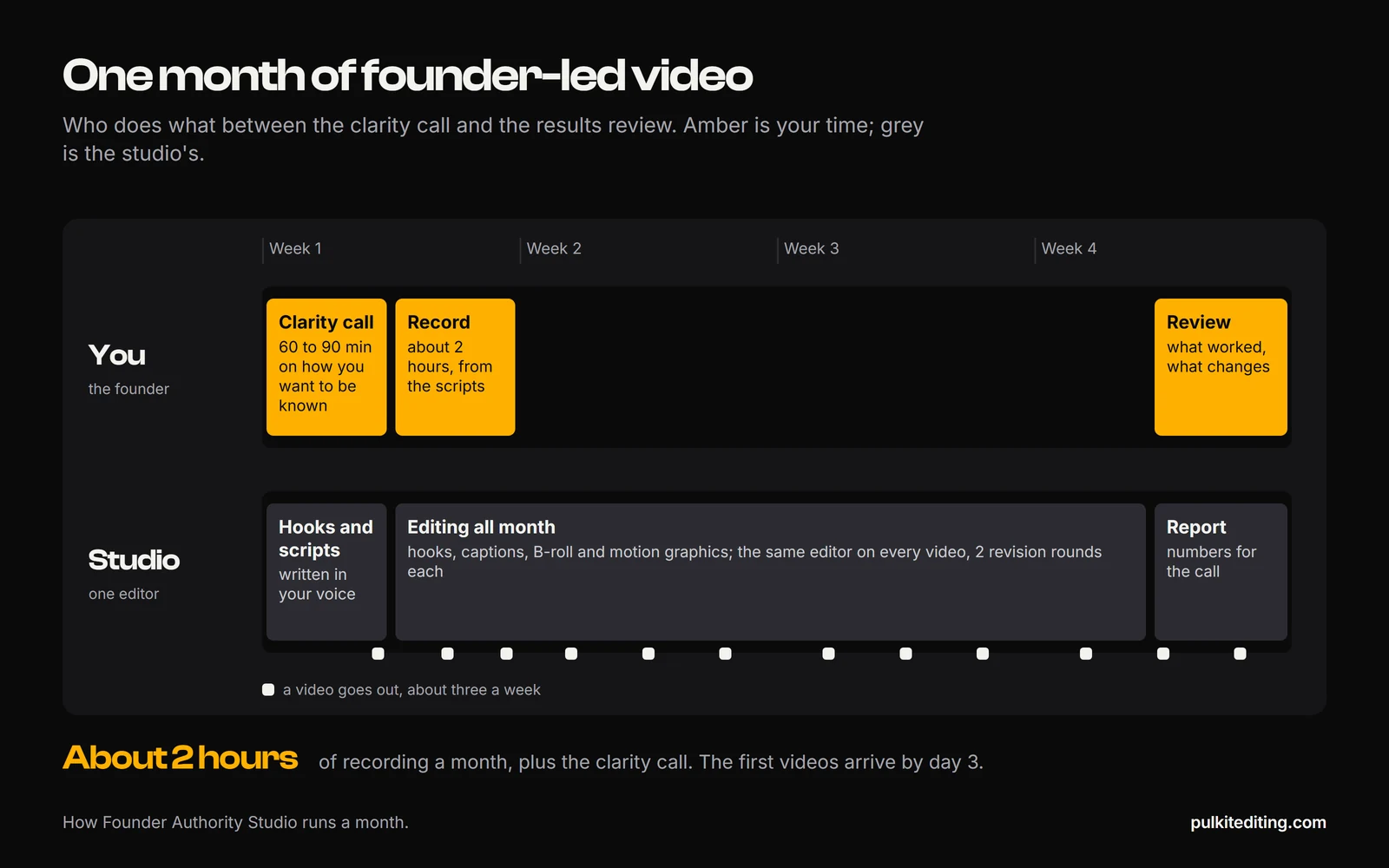
- Clarity call, 60 to 90 minutes. We pull your expertise, stories and opinions out of your head, and decide how you want to be known.
- Hooks and scripts, written in your voice from that call. You approve them; you don't write them.
- Recording, about 2 hours. You read from the scripts in one sitting, in one setup, recording each hook three ways.
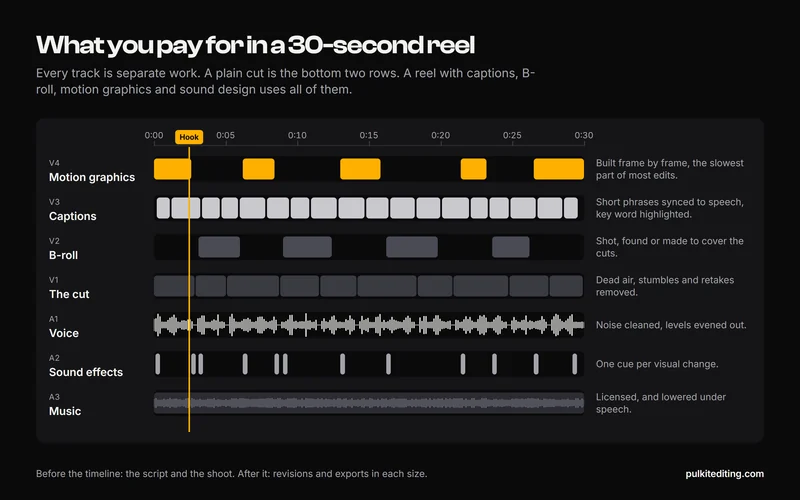
- One editor for every video. Hooks, captions, B-roll and motion graphics, with 2 revision rounds each. The same person edits all your videos, so they learn your pace and your face.
- Posting, about three a week. Twelve videos covers a month at that pace.
- The month-end review. A short report and a call on what worked and what changes next month.
The first videos arrive within 3 days of the clarity call. After that, the only fixed dates in your calendar are the call, the recording and the review.
What to talk about: four places topics come from
Founders rarely run out of things to say. They run out of things they've already decided to say. On the clarity call I sort topics into four piles:
- Expertise: how you do the thing your customers pay for. Frameworks, mistakes, how-tos, the questions prospects ask on sales calls.
- Stories: the founding moment, the client who almost left, the hire that went wrong, the decision you would make differently.
- Opinions: where you disagree with your industry, and why. Only takes you can defend for the next 20 seconds of the video.
- Proof: results, behind-the-scenes work and client wins, shown with their permission.
For a first month of 12 videos, I would start with four from expertise, three stories, three opinions and two proof. Expertise brings the right viewers in, stories and opinions make them remember you, and proof makes the next step feel safe. Then the numbers from the review shift the balance.
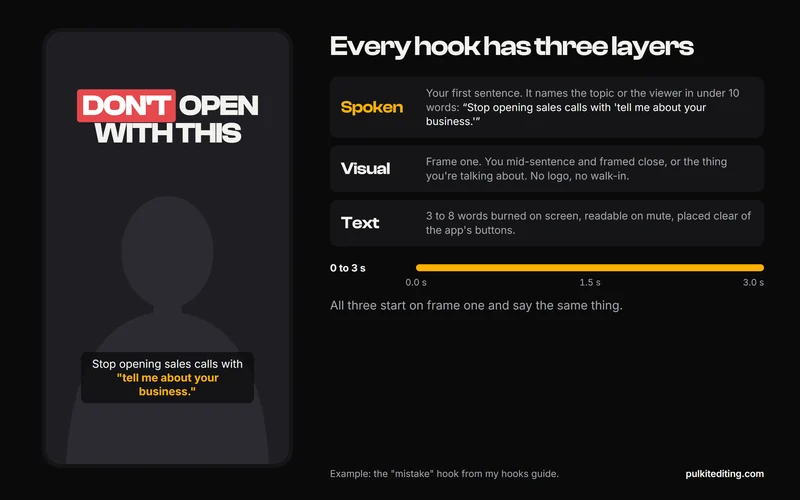
Each topic still needs a hook. The seven hook formulas map neatly onto these piles: the mistake and the insider hooks suit expertise, the story drop-in suits stories, and the contrarian take suits opinions.
One recording session, a month of videos
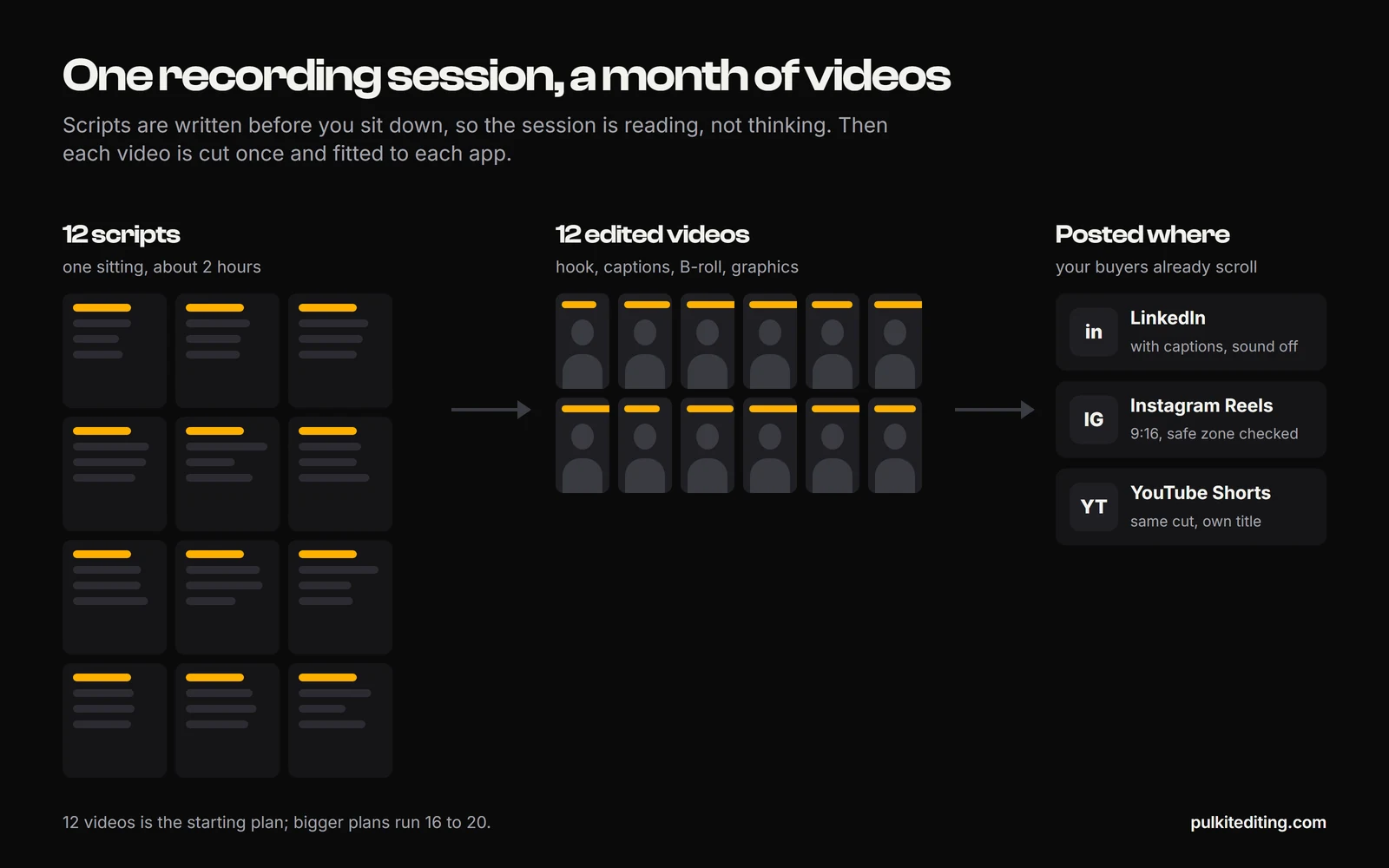
The session works because the thinking is already done. A few things make it go faster:
- Use a teleprompter app, or keep the script as a hook plus 3 to 5 bullet points if you talk better without one.
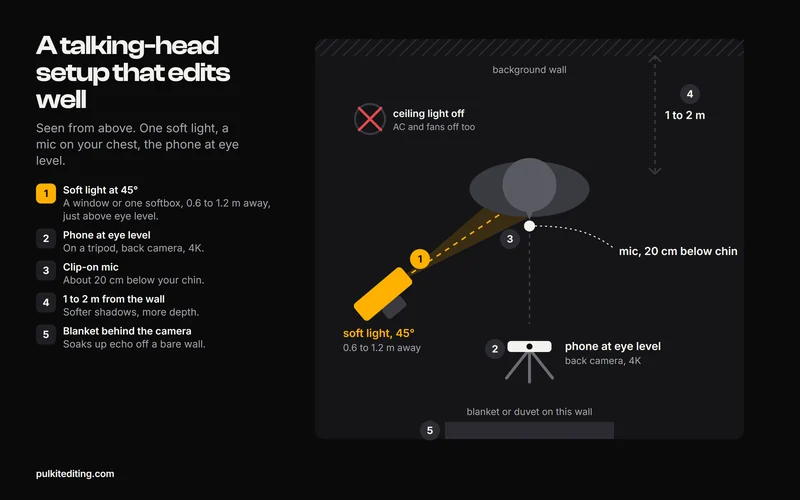
- Keep one setup for the whole session, so every video in the month matches. A change of shirt between batches makes the month look less like one sitting.
- Leave a one-second pause between points and clap before any retake, so the edit is quick.
- Record each hook three ways. Different openings can be tested later.
The full setup, from phone settings to the mic, is in how to film a talking-head video on your phone.
Where to post, and what changes per platform
Start where your buyers already spend time: LinkedIn for most B2B founders, Instagram for consumer brands and coaches. The same vertical edit can go to LinkedIn, Instagram Reels and YouTube Shorts, with a few changes:
- LinkedIn: captions are not optional. LinkedIn says 79% of video in its feed is watched with the sound off, so the hook has to be on screen in the first frame.
- Instagram Reels: keep text and your face clear of the app's buttons and caption. The measured safe zone has the pixels.
- YouTube Shorts: give each video its own searchable title. YouTube's "Stayed to watch" figure tells you how many viewers got past the opening.
What to measure, and what not to promise
Nobody can honestly guarantee views. What you can track each month:
- how many viewers stay past the first few seconds, which tells you whether the hooks work,
- average watch time, which tells you whether the video keeps its promise,
- saves and shares, which tell you whether people found it useful,
- profile visits, DMs, inbound enquiries and booked calls, which tell you whether it is building the business.
The last one matters most. A founder video with modest views that brings in two qualified conversations has done its job. The month-end review is where those numbers change next month's topics.
Expert-to-camera reels I've edited
An education brand and a clinic, each with the expert talking straight to camera and graphics carrying the main points.
Doing it yourself, with a freelancer, or with a studio
You can run all of this yourself with a phone and a free editing app. Most founders can manage the recording; it is the scripting and the weekly editing that eat the time. A freelancer takes the editing off you, but the scripts and the plan usually stay with you. A studio plan covers the whole loop. If you are weighing the cost, I've broken down what video editing costs in India, including what an in-house editor really costs.
Questions people ask
What is founder-led content?
Content where the founder is the face and the voice: short videos, posts and talks in which the person who built the company explains what they know. In the 2024 Edelman-LinkedIn survey, 73% of B2B buyers said thought leadership is a more trustworthy way to judge a company than its marketing materials.
How much time does founder-led video take?
In my system, one 60 to 90 minute clarity call a month and about 2 hours of recording from scripts written for you. Everything else, from editing to captions and posting files, is handled by the editor.
How many videos should a founder post a week?
Three a week is what 12 videos a month gives you, and it is the starting point I use. I would rather see a founder post three a week for a year than every day for a month and then stop.
Which platform should founders start with?
Where your buyers already spend time. For B2B that is usually LinkedIn; for consumer brands and coaches, Instagram. The same vertical video can go to both with its own caption.
Can I use an AI avatar instead of recording?
You can mix them. On the AI Twin plan I build an avatar of the founder and mix it with filmed videos; for our clients, avatar videos have matched the views of their filmed ones. Keep the filmed ones for stories and opinions.