In short: a hook is the first 1 to 3 seconds of a video, and it has three layers: the first sentence you say, the first frame people see, and the words on screen. Name the topic or the viewer in under 10 words, start on that sentence with no greeting, and burn 3 to 8 words of it onto the screen so it works on mute. Then pick the formula that fits the point of the video.
Why the first three seconds decide the rest
If the hook misses, the rest of the video doesn't get watched, however good it is. The platforms measure this directly:
- YouTube shows a "Stayed to watch" figure for every Short: the share of viewers who kept watching past the first few seconds.
- Facebook and Nielsen found that people who watched a video ad for under 3 seconds still showed a 47% lift in ad recall. The opening works even on people who scroll on.
- LinkedIn says 79% of video in its feed is watched with the sound off.
- In a 2019 survey of 5,616 US adults by Verizon Media and Publicis Media, 69% said they watch video with the sound off in public.
So a founder's hook has to work twice: once for people listening, and once for people reading the screen on mute.
The three layers of every hook
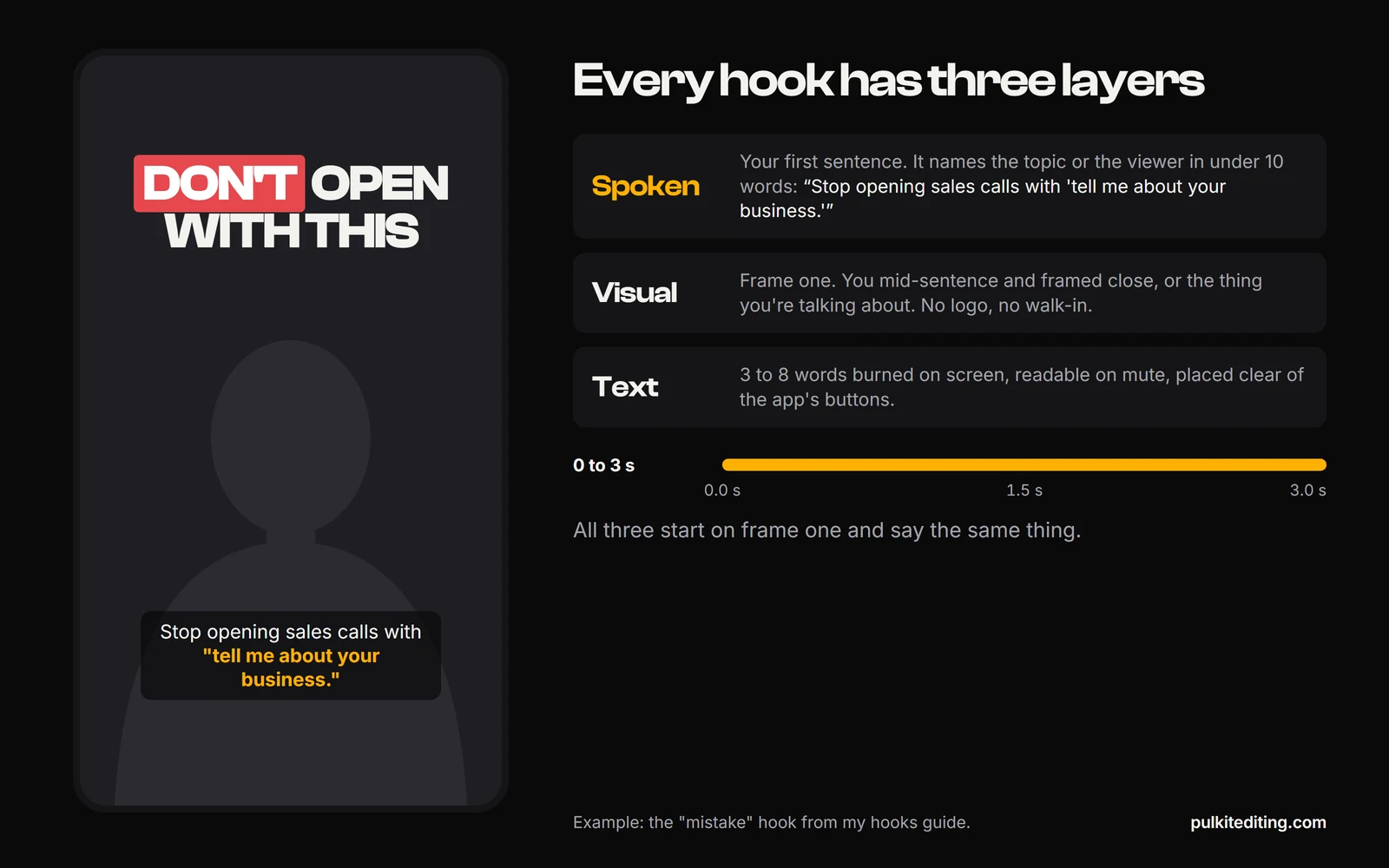
| Layer | What it is | What good looks like |
|---|---|---|
| Spoken | The first sentence you say | Names the topic or the viewer in under 10 words. No greeting, no name, no "in today's video". |
| Visual | What is on screen in the first frame | You, already mid-sentence and framed close. Or the thing you're talking about: a screen, a product, a result. |
| Text | The headline burned onto the video | 3 to 8 words that make sense on mute, placed where the app's buttons and caption won't cover them. |
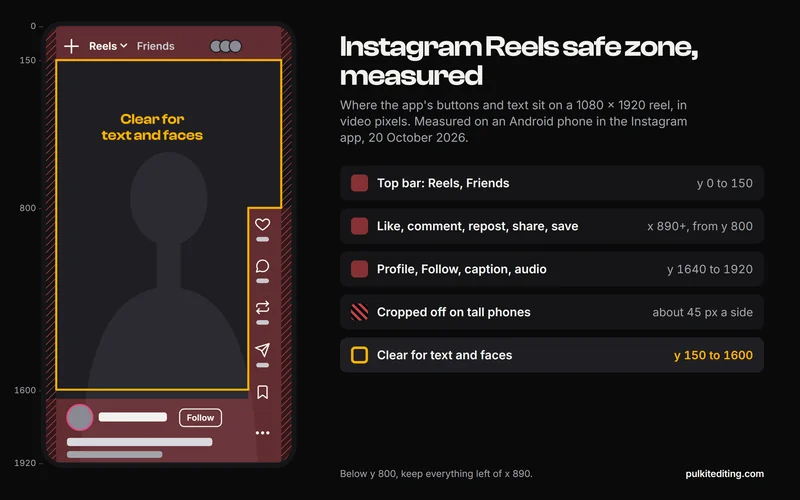
The text layer is the one I most often find missing, and it is the one LinkedIn's sound-off viewers see. Where it sits matters too: my measured Reels safe zone shows which parts of the frame the app covers.
What 47 education reels opened with
In October 2026 I transcribed the opening lines of 47 short-form reels from three education creators, Brainblast, PeakPrep and Niceville Tutoring, and sorted them by hook type.
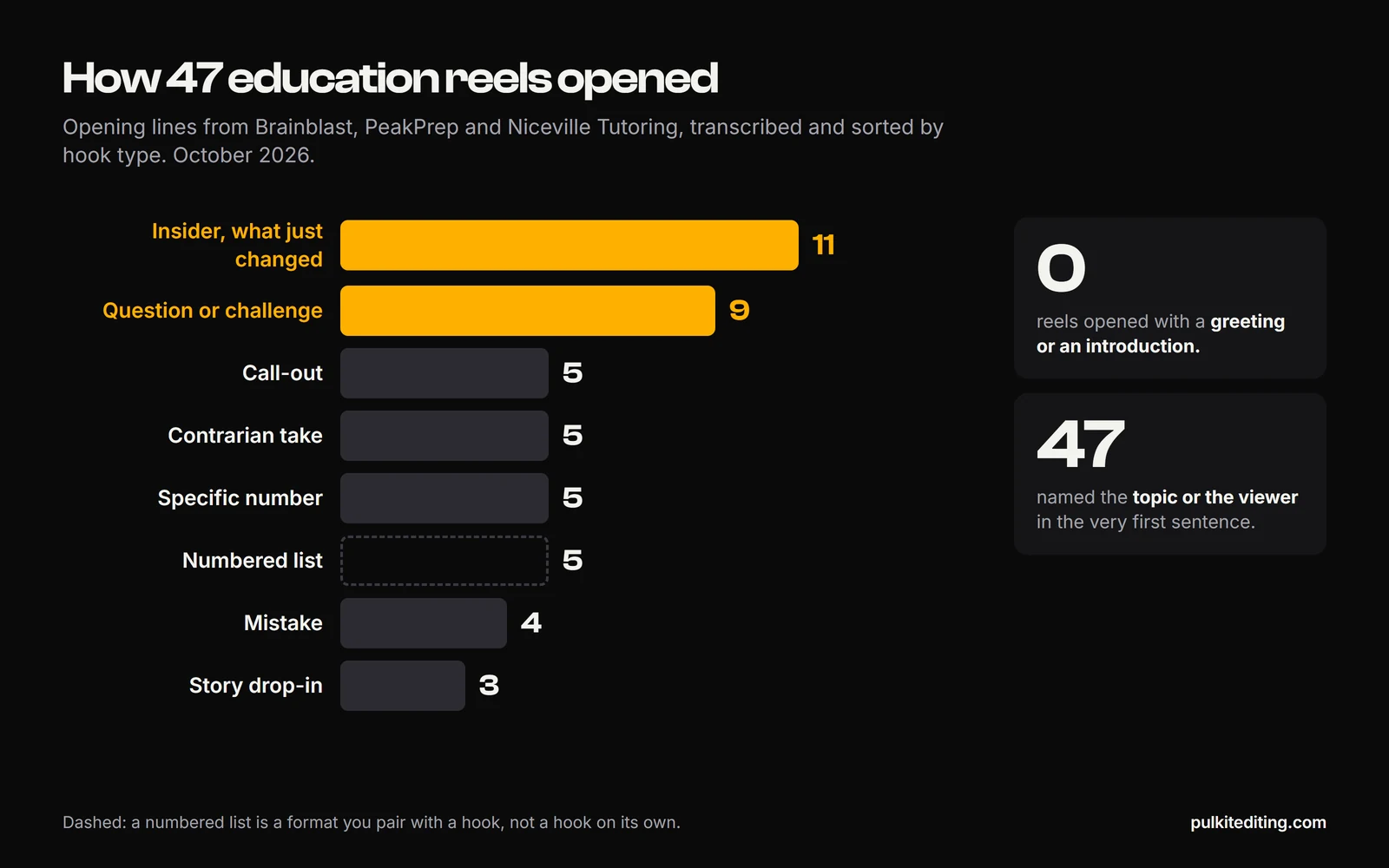
Two things stood out. Not one of the 47 opened with a greeting or an introduction, and all 47 named the topic, or the person it was for, in the first sentence. Beyond that they mixed their hooks: no single type opened more than a quarter of them. Pick the hook that fits the point of your video, not the one that is trending.
A numbered list ("3 mistakes that...") shows up in the chart, but treat it as a format. Pair it with one of the seven hooks below.
Seven hook formulas, with the edit for each
Swap anything in [brackets] for your own real numbers. A hook with an invented number costs you more trust than it wins.
1. The call-out
Formula: "If you're a [specific person] who [specific situation], [what they get]."
- "If you're a founder still writing every post yourself, this will save you [5] hours a week."
- "Coaches charging under [₹50,000]: this is why your sales calls don't close."
Use it when your audience is narrow and you want the right people to stop. People notice things about themselves even when their attention is elsewhere, the way you hear your own name across a noisy room. In the edit, put the label on screen in frame one, big and centred, such as FOUNDERS WHO SELL ON CALLS, so the right viewer reads it before you finish the sentence.
2. The mistake
Formula: "Most [people like you] get [thing] wrong. Here's the fix."
- "Stop opening sales calls with 'tell me about your business'."
- "You're losing deals on the first call because of one question you never ask."
Use it when you can name a common error and show the fix inside the video. Bad news and threats get more attention than good news (Baumeister and colleagues, 2001), so a mistake the viewer might be making feels urgent. In the edit, show the wrong way for one second with a red DON'T on screen, then cut hard to you explaining the fix.
3. The contrarian take
Formula: "[Common advice] is wrong. Do this instead."
- "Posting every day is the worst advice I ever took on LinkedIn."
- "I stopped doing discovery calls. Our close rate went up."
Use it only when you genuinely disagree and can back it up in the next 20 seconds; a take you can't defend costs trust. It works because it clashes with something the viewer already believes. In the edit, open on the boldest line with a hard cut and no music build-up, and put the claim on screen in quotation marks.
4. The question or challenge
Formula: "Why does [surprising thing] happen?" or "Can you spot what's wrong with this [pitch, ad, email]?"
- "Why do some founders get [50] inbound leads from one post and others get none?"
- "This cold email booked [12] calls in a week. Can you spot why?"
Use it when the answer is genuinely interesting and arrives in the same video. Avoid yes-or-no questions viewers answer in their heads, like "Want more clients?" Curiosity is the itch of a gap in what you know, and people act to close it (Loewenstein, 1994). In the edit, put the question on screen word for word and push in slowly on your face as you finish it.
5. The specific number
Formula: "[Exact number] [result] in [time]. Here's what did it."
- "We went from [3] to [41] inbound calls a month without running ads."
- "[₹18,40,000] in sales from one LinkedIn post. Here's the post."
Use it when you have a real result you can show. Sharp numbers like 18,40,000 read as measured, so people believe them more than a round 20 lakh (Schindler and Yalch, 2006). In the edit, count the number up in the first second, then show the proof, a dashboard or an invoice, by second three.
6. The story drop-in
Formula: start in the middle of the moment. "[When], [what went wrong]."
- "Last Tuesday a client fired us over one email."
- "Two years ago I had [₹40,000] in the bank and payroll due on Friday."
Use it when the lesson came from something that happened to you or a client. Skip the backstory and start at the tense moment. The more absorbed people get in a story, the more they warm to its main character (Green and Brock, 2000). In the edit, open on a photo or clip from that moment, not on your face, with a small sound hit on the first cut.
7. The insider, or "what just changed"
Formula: "Nobody tells you this about [X]." or "[Platform] just changed [thing]. Here's what to do this week."
- "What investors actually look at in the first 30 seconds of your deck."
- "[Platform] just changed [feature]. Here's what it means for your next post."
Use it when you have inside knowledge or fresh news your audience will act on. News is only useful if you act on it now, which gives people a reason to watch now. This was the most common opener in the 47 reels. In the edit, open on a screenshot of the news or the document, with you cut out in the corner talking over it.
Hooks from reels I've edited
On these, the text layer does most of the work in a few words. In SAT reel 13 the line "This SAT math Desmos trick feels illegal" gets all three layers at once: it is spoken, the word ILLEGAL sits behind the presenter, and the caption repeats it. The two Hot Wheels reels put an insider line and a bold claim on screen: "most fans don't know this" and "every ferrari is worth a ton".
Hook mistakes I fix most often
| Mistake | Why it hurts | The fix |
|---|---|---|
| Opening with "Hi, I'm [name], founder of [company]" | Your name is already on the post. The first seconds go to something nobody asked for. | Start on the hook. Introduce yourself later, or not at all. |
| A logo animation or branded intro | It delays the point and says nothing on mute. | Cut it. Put the logo in the last frame if you want it. |
| Context before the point: "So I was thinking about..." | Viewers decide before the interesting part arrives. | Say the conclusion first, then how you got there. |
| A hook that only works with sound | 79% of LinkedIn feed video is watched on mute. | Burn the hook onto the screen in frame one. |
| Long on-screen text, or text in the wrong place | Nobody reads 20 words in 2 seconds, and the buttons cover the bottom and right edge. | 3 to 8 words, in the upper middle of the frame. |
| Dead air: walking into frame, "um", a breath | Half a second of nothing reads as nothing happening. | Trim so the video starts on your first word. |
| A hook the video doesn't pay off | People leave early, and early drop-off is exactly what platforms measure. | Only promise what the next 30 seconds deliver. |
The 30-second hook check
Run every video through these before it goes live:
- The first word I say is part of the hook, not a greeting or my name.
- The hook names the topic or the person it's for in under 10 words.
- Frame one shows me mid-sentence, or shows the thing I'm talking about.
- The hook is on screen as 3 to 8 words, clear of the app's buttons.
- It makes sense with the sound off.
- Any number in it is real, specific and shown as proof by second three.
- The video delivers what the hook promised within 30 seconds.
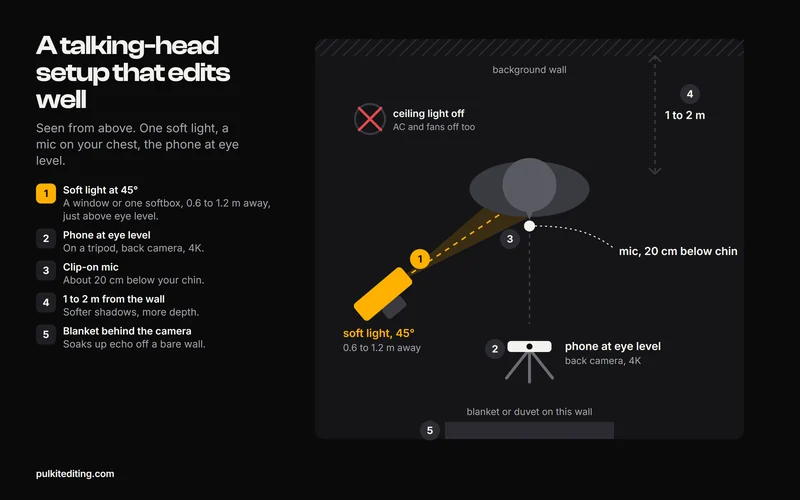
Record three versions of your hook at the end of each shoot. It takes a minute, and your editor can test which one opens the video. If you're filming yourself, this phone setup makes the hook easier to cut.
The printable version, with every source: download 7 Hooks That Make Founder Videos Get Watched (PDF).
Questions people ask
What is a video hook?
The first 1 to 3 seconds of a video: what people hear, see and read before they decide to keep watching or scroll. A hook has three layers, the first spoken line, the first frame and the on-screen text, and the strongest hooks have all three saying the same thing.
How long should a hook be?
Say the hook in under 10 words and put 3 to 8 words on screen. The whole opening should land inside 3 seconds, because that is roughly when viewers decide.
Should I introduce myself at the start of a video?
No. Your name is already on the post, and a greeting spends the first seconds on something the viewer didn't ask for. In my study of 47 education reels, not one opened with a greeting or an introduction.
What is the best hook for a LinkedIn video?
One that works on mute, because LinkedIn says 79% of video in its feed is watched with the sound off. Burn the hook onto the screen as text in the first frame, and pick the formula that fits the point of the video.
Do clickbait hooks work?
They win the first 3 seconds and lose the rest. Platforms also measure how long people stay, so a hook the video doesn't pay off shows up as early drop-off.
Sources
- Understand your YouTube content performance ("Stayed to watch" for Shorts), YouTube Help
- Brand lift happens in less than 1 second of video, study finds, Marketing Dive, 2015
- 4 tips for better video ads on LinkedIn, LinkedIn Marketing Blog (79% of feed video watched without sound)
- 80% of video caption users aren't hearing impaired, Streaming Media (Verizon Media and Publicis Media, 2019)
- Selective attention, Introduction to Psychology, UPEI
- Bad is stronger than good, Baumeister et al., Review of General Psychology, 2001
- The psychology of curiosity, Loewenstein, Psychological Bulletin, 1994
- Round numbers, sharp numbers, and their perceived credibility (Schindler and Yalch, 2006)
- Transportation into narrative worlds (Green and Brock, 2000), OnFiction